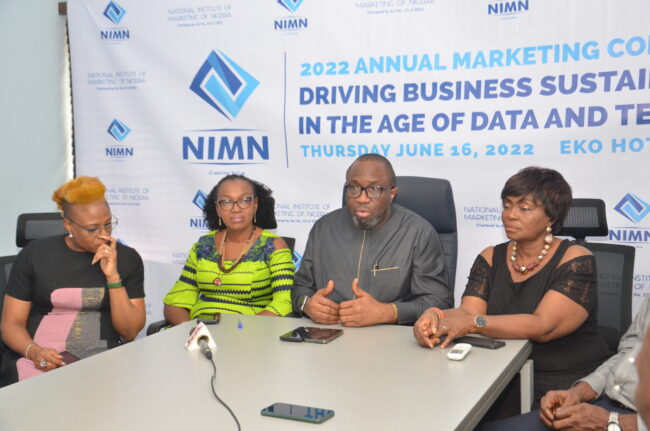
and Adenike Olufade.fnimn Council member and Chairperson of Events and Conferences Committee of all the National Institute of Marketing of Nigeria (NIMN) during the parley with media to sensitize them on the Ànnual Marketing Conference (AMC 2022) at the NIMN National Secretariat in Lagos recently
National Institute of Marketing of Nigeria (NIMN) is set to hold its Annual Conference, AGM and induct New Fellows.
This was said by the President of the National Institute of Marketing of Nigeria (NIMN), Mr. Idorenyen Enang during a media parley today in Lagos charged practitioners of the Integrated Marketing Communications industry as well as other stakeholders to leverage the forthcoming Marketing Conference billed to hold on the 16th of June to acquire knowledge on strategic business management and sustainability.

“The National Institute of Marketing of Nigeria is going through a rebirth and that rebirth is starting from the mind, the quality of the dialogue, conversation, and the people,” he said.
Chairman Planning Committee, Chioma Afe, emphasized on the theme “Driving Business Sustainability in the Age of Data and Technology”. In search of something that speak to who we are now as marketers, as business people in Nigeria coming out of the pandemic which is now endemic, understanding that businesses are changing in how they operate and understanding the core nature of marketing in every business. So as a body of marketer, a ruby marketer and an established marketer, how are you doing differently and what are people doing to disrupt and how is marketing coming together with technology to do things differently in business to drive sustainability. The conference is scheduled on June 16th at Eko Hotel and Suite at 10am and we expect to have a four hours of conversation of networking, engagement and discussions with quintessential keynote speaker and panelists.
She added that the keynote speaker would be coming from the technologies/telco business reason that telco has pivoted over the last 5years and they are changing the narrative looking at payment, financial inclusion and doing all sort of things now.
The conference is expected to attract not just NIMN members but also non members speaking to marketers as a whole and this cut across corporate organizations across all the industries as well as agencies and all those who enables businesses as well, SMEs, entrepreneurial and all those kind of professionals are the kinds of people we are encouraging to attend the conference.
The first panels will be Disruptive Marketing. The marketing ecosystem is made up of all sort of players so we got Experiential Marketing, PR experts, FMCG type businesses, we got other businesses that are part of this marketing ecosystem and its a panel that will feature four of the key players in this businesses discussing how are they disrupting , what is disruption in marketing and how have they disrupted over the past year or two. So, will be having a panelist from EXP, TBWA, 7up Bottling Company and from Allied foods. The next panel is the Future of Marketing in the Age of Data and Technology which will feature innovators looking at disruptors and people who are running businesses as entrepreneurial , we have the Co-founder ZA Africa, we have professor Uchenna Uzor from Lagos Business School, we have Head of Marketing, Koro Pay on that panel.
Sidney Ogodo, NIMN, Registrar, also said the 17th June, 2022 will be the Annual General Meeting (AGM) of the institute with an election for the position of the 1st Vice President and 2nd Vice President and voting will commence on the 3rd before the AGM via electronic platform to enable every members of the institute within and outside the shores of Nigeria to exercise their franchise.
Participants are required to register on the institute’s website as limited slots are still available.

