
The WARC Media 100 2025 rankings reveal the most awarded media campaigns, agencies, and brands, with ‘Welcome to the Group’ taking the top spot.
Ranked #1: Campaign: ‘Welcome to the Group’ by PHD Costa Rica for Nosotras Women Connecting Agency: Mediaplus Munich Network: Mindshare Worldwide | Independent network: Serviceplan Holding Company: WPP Brand: Dove Advertiser: Unilever Country: United States Overcoming fragmentation with distinctive assets, the cut-through power of print and the power of utility are key themes of the world’s most awarded campaigns for media 18 March 2025 – The WARC Media 100, the ultimate independent global benchmark of the world’s most awarded campaigns and companies for media, is now released. Compiled by WARC Creative, helping companies deliver creative marketing that works, the annual Media 100 Ranking is an aggregate of the results of the most important global and regional media awards of 2024. The shows tracked are determined in consultation with the WARC Rankings Advisory Board and by a yearly global panel survey. Anna Hamill, Senior Editor, WARC Creative, said: “The WARC Media 100 are annual worldwide league tables of the most awarded campaigns and companies for media excellence. A global benchmark for the industry, they showcase the best use of media and the impact it can have on a campaign’s success.” The three key themes from this year’s Media 100 are: Overcoming fragmentation with distinctive assets: Brands such as CeraVe, Barbie and Sprite tapped into their distinctive brand assets, such as brand colours, characters and memes, to create a recognizable presence across various media platforms, overcoming fragmentation and generating viral cultural moments for mass reach. The cut-through power of print: With online content and advertising at saturation point, top performing campaigns like L’Enfant Bleu’s children’s book and eBay’s partnership with Vogue, indicated the enduring power of print formats as a clever attention-grabber, especially for targeted audiences, such as fashion lovers or parents. The power of utility: This year’s rankings highlighted the power of utility in consumer tech to solve real-world problems. Nosotras Women Connecting used WhatsApp groups to influence political change, Mercado’s Handshake Hunt leveraged QR codes to drive sales, and PetPace used real-time data from pet collars to assess earthquake risks. #1 Campaign for media: ‘Welcome to the Group’ by PHD Costa Rica for Nosotras Women Connecting The most awarded campaign for media in 2024 was ‘Welcome to the Group’ by PHD Costa Rica for women’s rights NGO, Nosotras Women Connecting. The campaign convinced congress members to pass a menstrual justice bill using public media and PR stunts, social media, and a WhatsApp group. Alan Vainrub, Central America CEO, PHD, said: “Being ranked #1 in the WARC Media 100 is the highest recognition we could hope for with Welcome to the Group. It’s a testament to the power of media to drive meaningful change. We hope this achievement inspires our incredible team at PHD to keep pushing boundaries—and encourages others to create work that truly makes a difference in the world.” In second place is ‘The Hidden Story’ by Havas Play Paris, for L’Enfant Bleu, an association that fights against child abuse. The picture book addressed the risk of exposing children on social media prompting parents to consider the impact of their social media actions. In third, is ‘The Handshake Hunt’ by GUT São Paulo, for Mercado Libre. The Latin American ecommerce platform partnered with TV channel Globo during Black Friday, displaying QR codes for discounts whenever a handshake appeared on-screen to increase transactions in Brazil. #1 Agency for media: Mediaplus, Munich Independent agency Mediaplus Munich is top of the leaderboard after being third in 2024, and 14th in 2023. They have seven campaigns in the top 100 this year for brands including Long COVID Europe, Hinz&Kunzt/Hamburger Kunsthalle and Motatos. Max Schöngen, Global Creative Lead, Mediaplus, said: “It fills me with much pride to be named #1 Media Agency overall, especially as an independent. Frankly speaking, words won’t cover it. This incredible achievement is the result of relentless passion, bold ideas, and the unwavering commitment of our teams, partners, and clients who trust in the power of creative media.” Mindshare New York is in second place, with five campaigns in the top 100. EssenceMediacom New York is in third, up from 16th place last year. #1 Network for media: Mindshare Worldwide#1 Independent network for media: Serviceplan Mindshare Worldwide has gradually moved to the top of the Network rankings, reaching first place this year, after second in 2024, and fourth in 2023. There are five agencies in the top 50 that have contributed points – New York, Shanghai, Mumbai, Ho Chi Minh City and Bangalore – two of which are in the top five. Adam Gerhart, Global Chief Content Officer, GroupM, said: “As the media landscape rapidly evolves, WARC captures the breadth of what our industry is capable of – a collective view of innovation and ingenuity across commerce, technology, creative, and data. We’re thrilled to have two of GroupM’s networks in the top three, and two-thirds of the top ten from our global agencies. Congratulations to Mindshare as the #1 Global Media Network of the WARC 100, and to EssenceMediacom and Wavemaker for the incredible work. And to all our teams, clients, and partners – this is for all of you.” Essence Mediacom moves up to claim second position with five agencies in the top 50. PHD Worldwide is in third place. Serviceplan heads up the independent networks this year. Ranked campaigns include PetPace Animal Alerts, Anzen Health 855-HOW-TO-QUIT-(OPIOIDS), and BMW iJack. Its Mediaplus Munich agency tops the agency ranking. Max Schöngen, Global Creative Lead, Mediaplus, added: “We are beyond proud and deeply grateful to be named #1 Independent Media Network in the prestigious WARC MEDIA 100. For us, this is more than just a ranking. It is the pinnacle of our industry and the benchmark we’re striving for day in and day out. Being an integrated group allows us to combine the forces of Media, Data and Creation, pushing boundaries and redefining what media can do. This is not just a milestone—it’s fuel for the future. Rocket Fuel.” #1 Holding Company for media: WPP WPP retains its top rank for holding company, a position held since 2018, with four networks in the top ten – Mindshare Worldwide, EssenceMediacom, Wavemaker and VML. Brian Lesser, Global CEO, GroupM, says: “I’m immensely proud to celebrate eight straight years at the top of WARC’s Media 100 with everyone at WPP and GroupM. We love the work we get to do for our clients, and we’ll continue building creative, competitive, and future-forward solutions that help them connect with audiences around the world. Congrats to our teams, clients, and partners on a well-earned win.” Omnicom is in second place for the eighth consecutive year. Publicis Groupe moves up one place to claim third. BlueFocus are new to the top 10 holding companies this year. #1 Brand for media: Dove Dove remains in top place this year with multiple campaigns in the top 100, including CROWN x LinkedIn: #BlackHairIsProfessional, #TurnYourBack, Cost of Beauty, and #KeepHerConfident. Marcela Melero, Chief Growth Officer of Dove Personal Care North America and Dove Masterbrand, said: “It’s a great achievement for the Dove team, and our partners worldwide, to be recognised in the WARC Media 100 for the second year in a row. Dove continues to lead the way, not only in the craft of compelling campaigns and content, but also in our ability to embed ourselves in culture, timelessly. This magic formula drives conversations at scale, helping us convert at shelf.” Entering the Media 100 for the first time are Warner Bros, in second place and Sprite in third. #1 Advertiser for media: Unilever Unilever remains at the top of the ranking. This is the sixth consecutive year that Unilever has taken the top spot. Brands contributing to their points tally include Dove, Lifebuoy, Vim and Sunlight. Esi Eggleston Bracey, Chief Growth & Marketing Officer, Unilever, said: “Wow – winning this award for the sixth year in a row is more than just a celebration of media excellence. This recognition celebrates our teams’ and agency partners’ incredible ability to optimize in media through smart data, strategic placement, and a clear mission to drive impact. Our unstoppable drive to innovate in the ever-changing media landscape ensures our messages hit home, reaching and resonating with the people we serve. This sets our team apart, so this award is for YOU! Special shout out to Dove for being recognised as #1 brand for the second year in a row. Their dedication to transform the beauty industry leaves no stone unturned.” The Coca-Cola Company, last ranked in the top ten in 2021, comes in second place. PepsiCo rises to third, up from ninth last year. #1 Country for media: USA The US retains its dominant position in the media rankings. 19 of the top 100 campaigns are US based. The UK remains in second place, as does India in third. Vietnam, China, Brazil, and Turkey all enter the top ten countries this year. The top ten most highly ranked campaigns and companies in the WARC Rankings Media 100 2025 are: 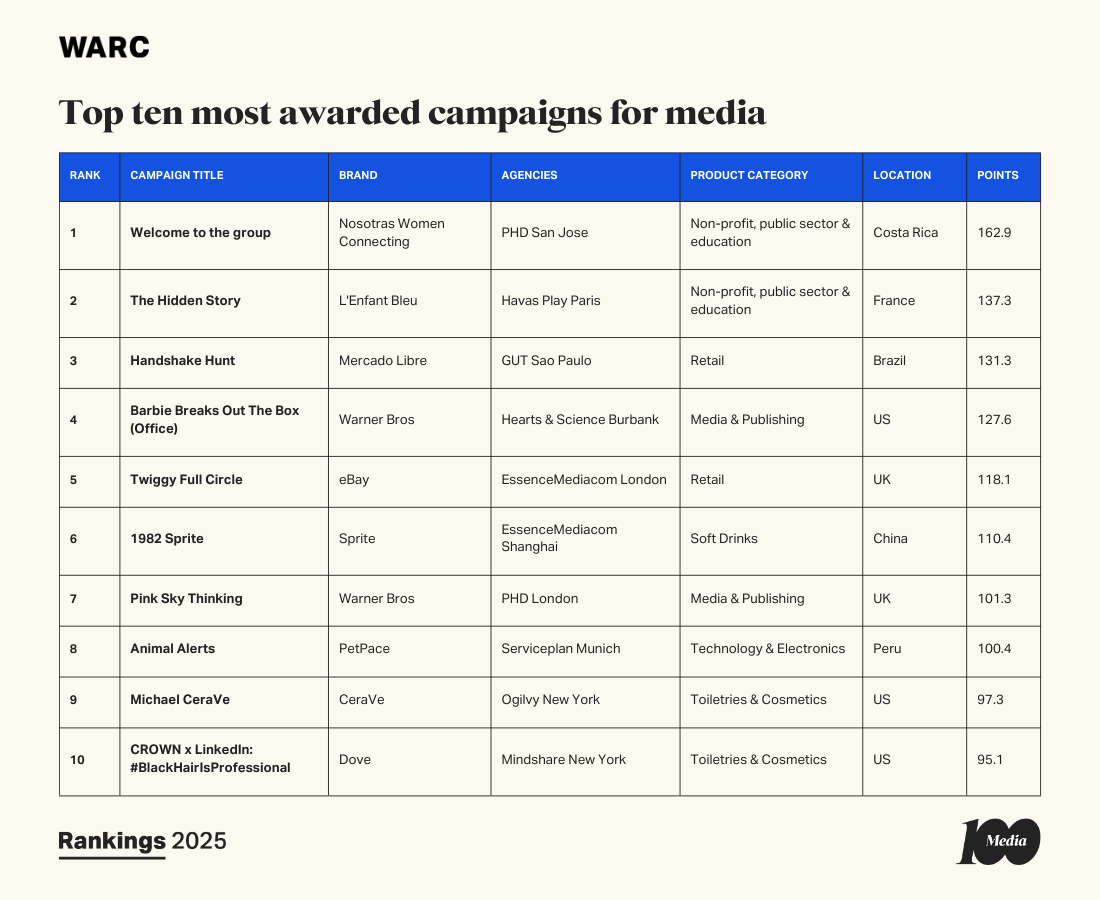 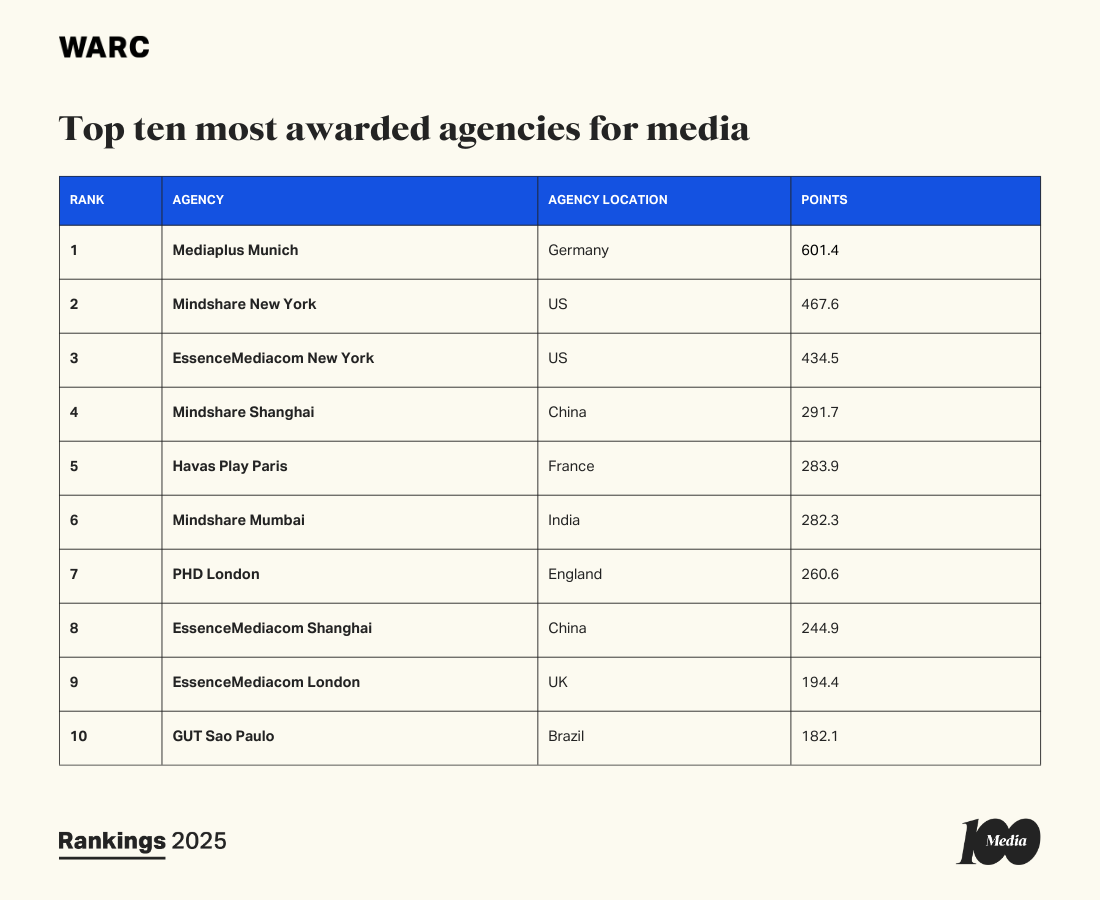 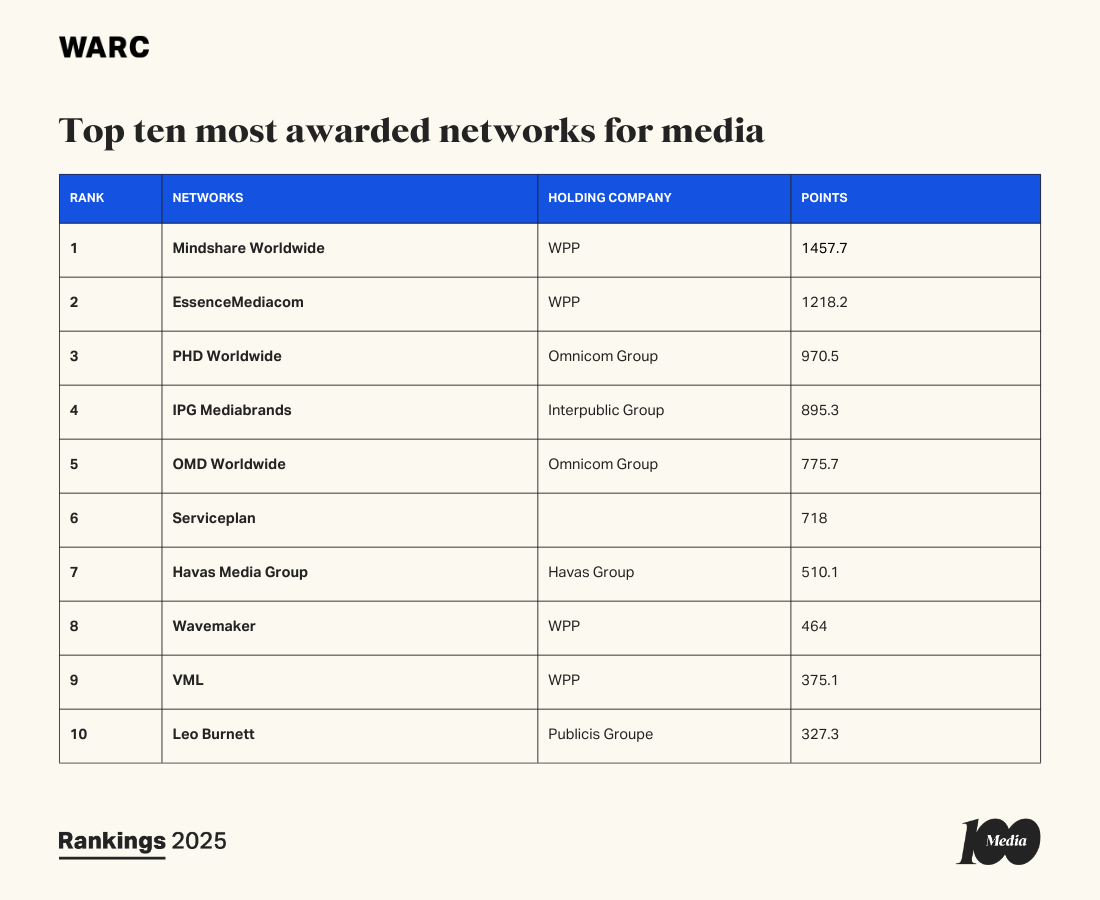 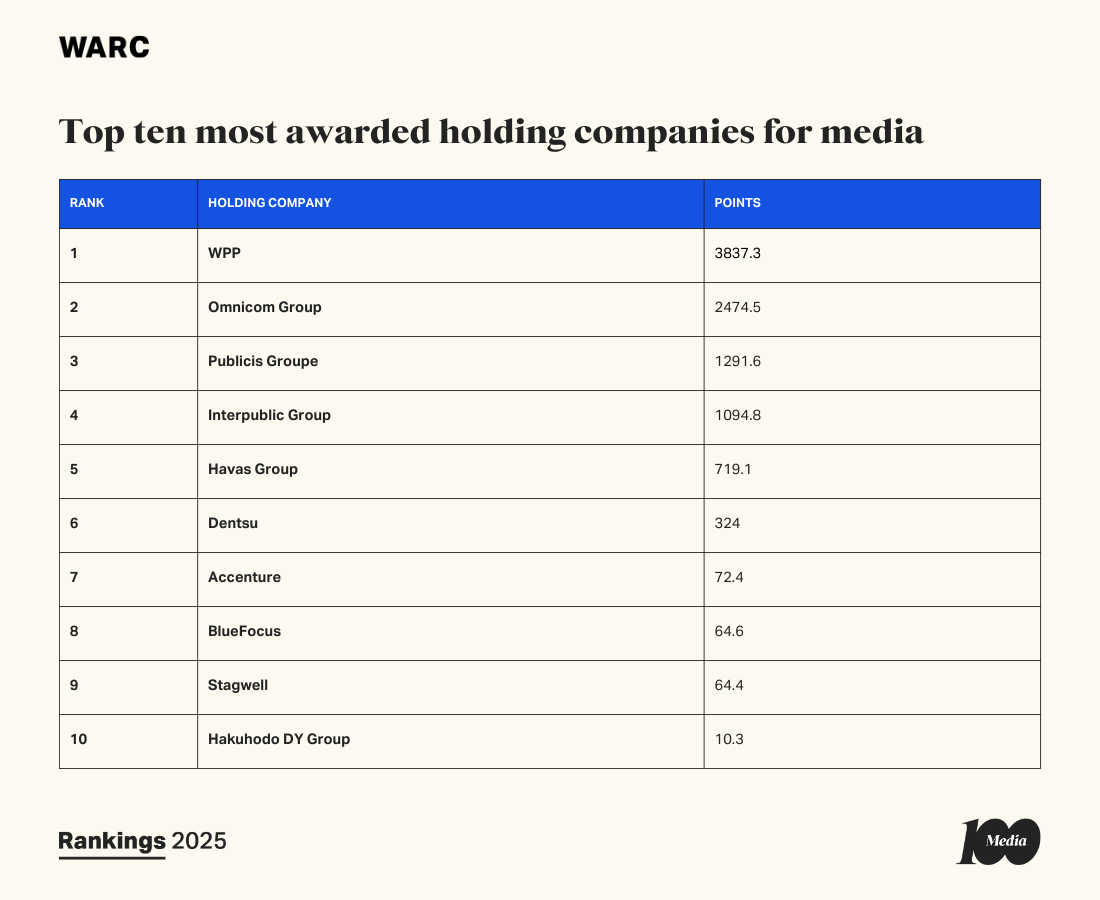 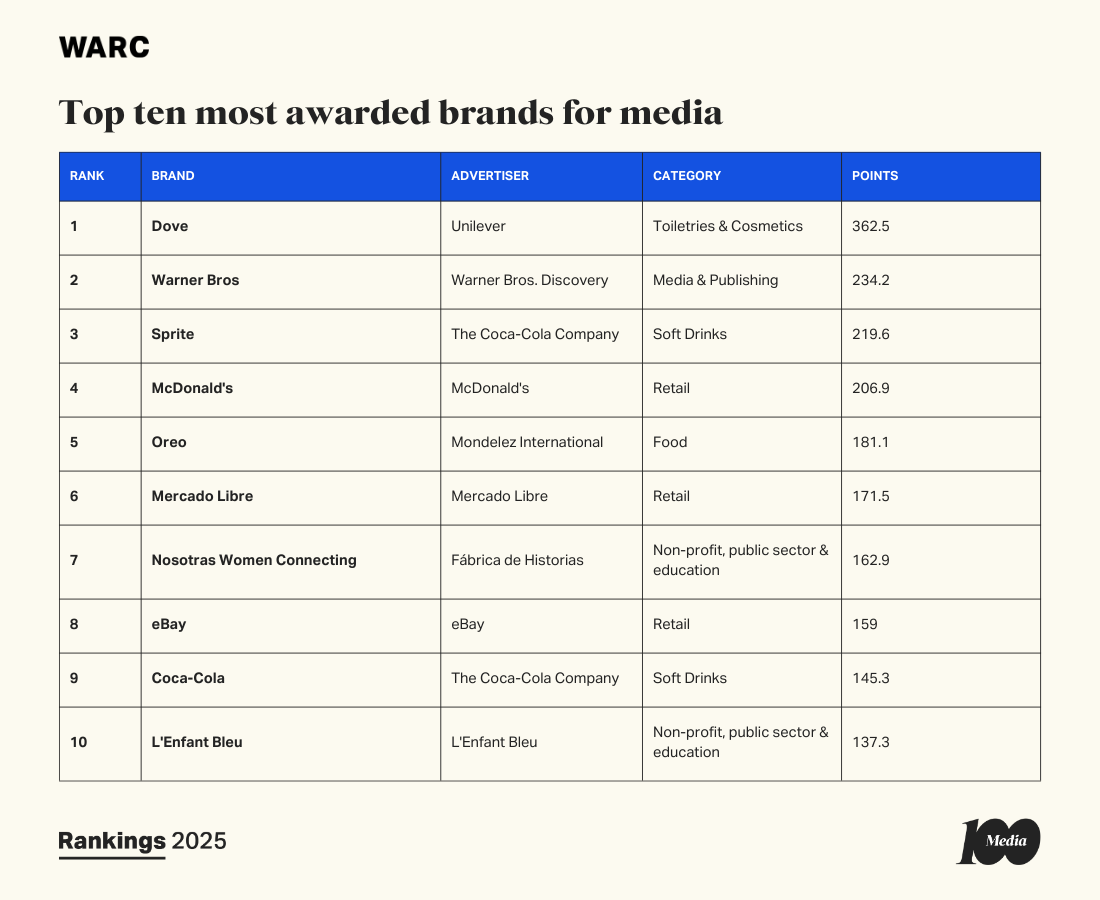 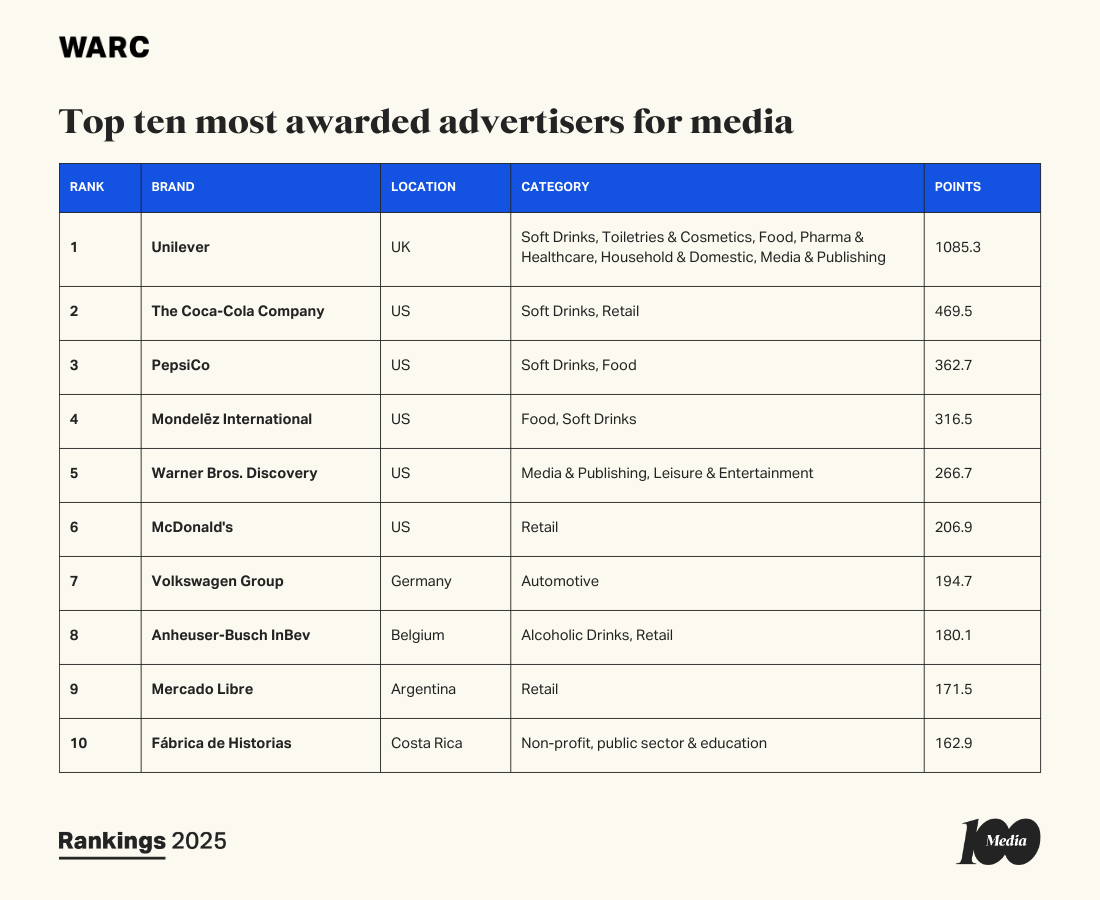 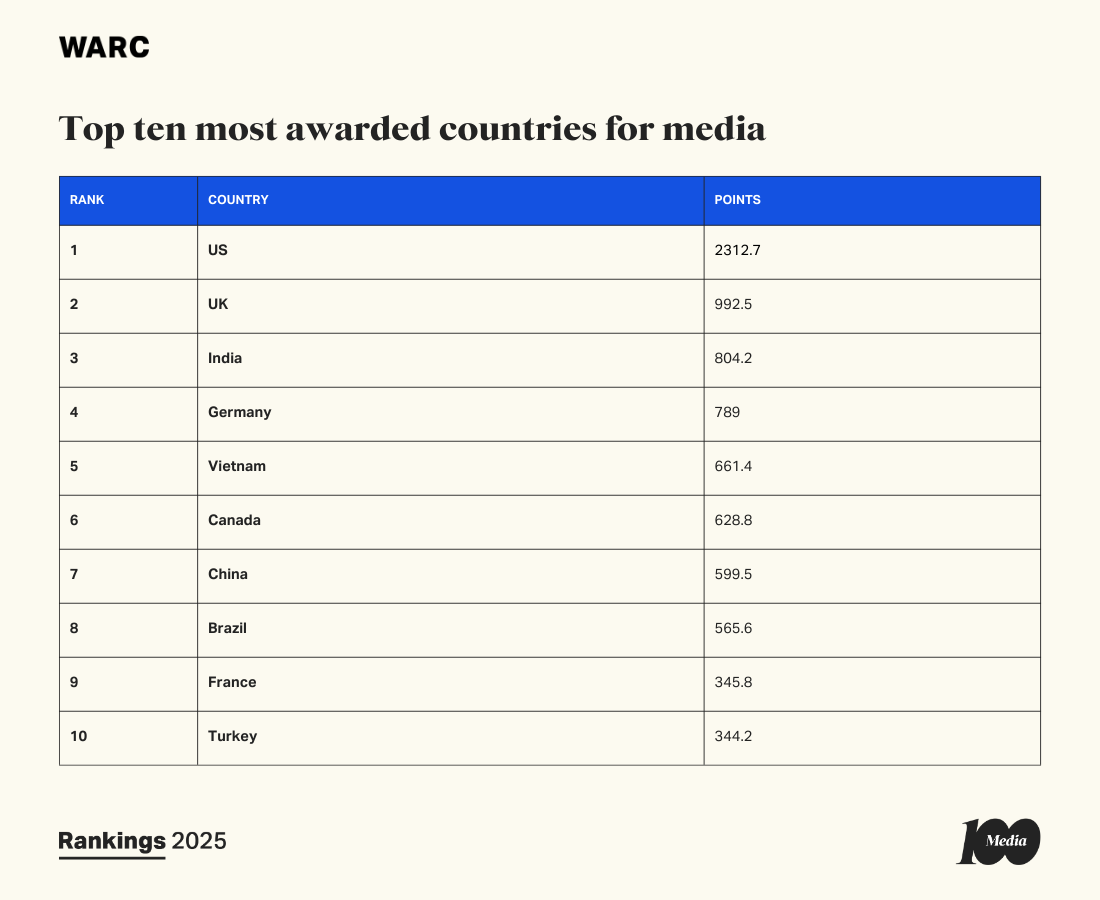 The WARC Media 100 has been compiled by applying a rigorous, unbiased and transparent methodology, and can be viewed in full with the campaigns here. It includes the world’s top 100 awarded campaigns for media, top 50 creative agencies, agency networks, brands, advertisers, countries and top holding companies. A WARC Media 100 podcast with PHD Costa Rica and Nosotras Women Connecting, deep-diving into the #1 campaign, ‘Welcome to the Group’ will be available from 18 March and a live webinar ‘The Winning Formula’, decoding the bold moves behind the winning work will be on Wednesday 2nd April 10am EST | 3pm BST. The case studies and summary report are available to WARC Creative members.The WARC Creative 100 can be viewed. The final Ranking – the WARC Effective 100 – will be announced on 25 March. |

