
TGI Group Reinforces Sustainability Leadership At BOI 2026 Conference As Executives Outline Resilience And Pragmatic Business Models

Tropical General Investments (TGI) Group has reaffirmed its position as a thought leader in African sustainability and agribusiness, with two of its senior executives delivering separate fireside chats at the Bank of Industry (BOI) 2026 Sustainability Conference. The sessions, held on Tuesday, November 17, 2026, at The Civic Centre, Victoria Island, Lagos, explored how businesses can build resilient food systems, climate-proof agricultural value chains and create long-term value through community-driven, execution-focused strategies.
Gumel Calls for Pragmatic, Community-Centred Sustainability
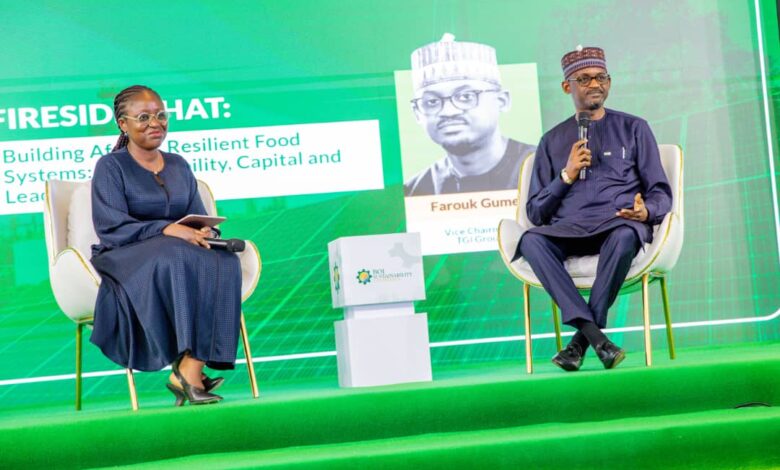
In a plenary session, Farouk Gumel, Executive Vice Chairman of TGI Group, participated in a fireside chat titled “Building Africa’s Resilient Food Systems: Sustainability, Capital and Leadership at TGI,” moderated by Mrs. Eniola Akinsete, Chief Sustainability Officer at BOI. The conversation examined the role of business leadership in strengthening food systems, the commercial case for sustainability in agribusiness, and the capital requirements for building resilient agricultural value chains.
Gumel said TGI’s approach to sustainability begins not with environmental targets but with the practical realities of operating in Nigerian communities. “We don’t start a venture thinking about profitability or thinking about sustainability. We start our businesses thinking about how to solve a problem,” he said. “Sustainability is about community and society. Without people, you can have all the greenery you want, but it’s weeds, they’re just grass, non-productive.”
He described TGI’s operational footprint—which includes BIG BULL Rice, Terra Seasoning Cubes, Golden Terra Vegetable Oil, Renew Starch and Chi Farms—as inseparable from the communities in which the Group operates. “We don’t own farms, we don’t have plantations. We work with outgrowers. We go straight to the communities, we register the people, they are our vendors,” he said, citing the Group’s joint venture with Wilmar International, covering approximately 40,000 hectares of palm plantation in Cross River State, as well as shea nut sourcing operations in Kwara that involve women’s groups across the supply chain.
On the commercial rationale for resilience, Gumel was direct: “Profitability in my sector means high volume, low margin. If you don’t have volumes, don’t play this game. For you to get scale, you need to capture people. For you to capture people, you need long-term, sustainable, inclusive funding.”
Asked for a closing leadership lesson, Gumel offered a characteristic response: “Let’s do less grammar. Let’s just go and do it. I did the PowerPoint thing. I was very good at it. And I moved from PowerPoint to pushing it and doing it.” He urged an evolutionary approach to industrial development: “We cannot leapfrog our reality. For you to be clean, you have to be dirty first. Industrialization is a messy job. Let us move slowly at our own pace so that we can be ourselves.”
In a concurrent session, Yosola Onanuga, Head of Corporate Responsibility and Sustainability at TGI Group, led a fireside chat titled “When the Weather Became a Business Risk: How WACOT Rice Rebuilt Its Value Chain for Resilience,” moderated by Mr. Chike Chukwuelue of BOI.
Onanuga explained how climate change evolved from a sustainability concern to a boardroom priority for WACOT Rice, a TGI Group member company. “A flood starts as a physical risk in a farmer’s field, but it can quickly become an operational risk when expected volumes do not arrive. That operational disruption can then become a commercial and financial risk through lost production, reduced revenue, pressure on margins and challenges around cash flow,” she said. “When a risk can materially affect earnings or cash flow, it naturally becomes a boardroom issue.”
She identified the company’s investment in people as its most valuable resilience intervention. “The biggest lesson we have learned is that resilience is ultimately a human capability. Technology matters. Infrastructure matters. Data matters. But none of these creates lasting value unless people have the knowledge, confidence and capacity to use them effectively.”
On access to capital, Onanuga noted that the expectations of financiers have shifted. “In the past, organisations often wanted to know whether you had a good project. Today, they want to know whether you have a credible strategy. They want to understand how you create value, how you manage risk, how you engage stakeholders and how you measure impact.”
She urged businesses to treat sustainability as a business transformation exercise rather than a compliance requirement. “Compliance may help you meet a requirement. Strategy helps you create value. The organisations that will succeed in the years ahead will be those that understand where they are exposed, act before those risks become crises and build businesses that create value not only for shareholders, but for the wider ecosystem they depend on.”
Earlier in the plenary programme, WACOT Rice Limited, a TGI Group member company, received the Award for Outstanding Corporate Leadership in Sustainable Practices, presented by Dr. Olasupo Olusi, Managing Director and Chief Executive Officer of BOI. The recognition acknowledged the company’s integration of economic, environmental and social impact into its core business model, including its outgrower programme and its captive power co-generation facility that generates 1 MW of electricity from rice husk.
The BOI Sustainability Conference, themed “Green, Resilient & Profitable: Redefining Nigerian Businesses for a Sustainable World,” convened business leaders, policymakers, investors and development finance practitioners to advance sustainable industrial growth

